


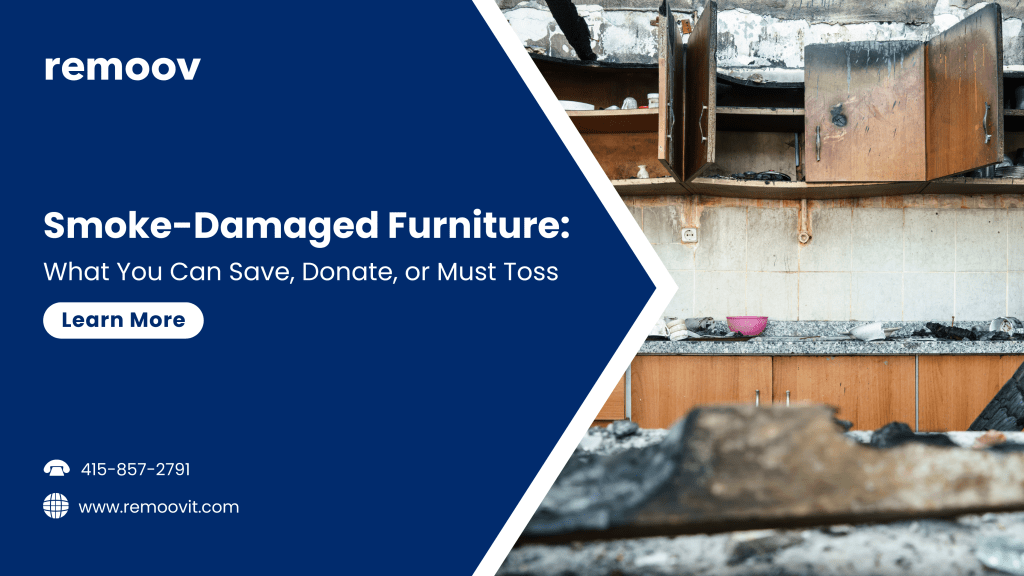
After a fire, the obvious damage is easy to spot. What’s harder is figuring out what’s safe. Smoke residue can travel fast, settle into fabrics, and cling to surfaces you thought were protected. Even when furniture looks fine, it can still hold soot, odor, and invisible contaminants that can irritate lungs and skin.
If you’re staring at smoke-damaged furniture and feeling stuck, you’re not alone. This guide breaks down what you can realistically save, what might be donation safe, and what you should toss without hesitation. You’ll also learn the smartest next steps if you want to keep items out of the landfill whenever possible.
First, know what smoke damage really means
Smoke damage is not just a smell. It often includes:
- Soot and ash particles that embed into fabric and unfinished surfaces
- Chemical residue from burned materials like plastics, foam, and treated wood
- Acidic deposits that can corrode metal parts and break down finishes over time
- Odor molecules that linger inside cushions, padding, and wood pores
The key question is not “Does it look okay?” The real question is, “Can it be cleaned thoroughly enough to be safe and usable?”
Quick safety rule before you decide anything
Use this quick rule of thumb:
- If soot is visible, the item is not donation-ready.
- If the item smells strongly even after airing out, it likely needs professional restoration or disposal.
- If the furniture has foam, fabric, or unfinished wood, smoke contamination is usually deeper than you think.
If you have children, seniors, or anyone with asthma or allergies in the home, lean more conservative. When in doubt, throw it out.
What you can usually save
Some furniture can be restored, especially when the smoke exposure was light and the item is mostly hard-surfaced.
1) Sealed wood furniture with light smoke exposure
Examples: varnished dressers, sealed dining tables, lacquered nightstands
You may be able to save these if:
- There is no charring
- There is no visible soot inside drawers
- The smoke smell is mild and improves after cleaning
What to do:
- Wipe down with a gentle cleaner and microfiber cloth
- Clean inside drawers and underneath the piece
- Replace drawer liners or soft inserts
- Let it air out in a dry, ventilated area for several days
If odor persists after a few days, professional deodorizing may be needed.
2) Metal and glass pieces
Examples: metal shelving, patio furniture, glass tables
These are often the easiest to save because smoke residue stays on the surface.
What to do:
- Wash thoroughly with warm water and soap
- Dry immediately to prevent corrosion
- Check joints, screws, and any hidden crevices
If the piece is rusting, sticky, or heavily coated, it may not be worth the effort.
3) Solid wood furniture that is not heavily porous
Solid hardwood can sometimes be saved, but it depends on the finish and smoke level.
Save it if:
- There is no soot staining that penetrated deep
- The smell is mild
- The finish is intact
If the wood is unfinished or raw, smoke can penetrate deeper and restoration becomes more difficult.
What might be salvageable only with professional help
These categories can sometimes be saved, but DIY cleaning rarely gets all the way there. If you love the piece or it has high value, professional restoration might make sense.
1) Upholstered furniture
Examples: sofas, recliners, armchairs, fabric headboards
Upholstery acts like a sponge for smoke. Even if the surface looks fine, the cushion foam and inner layers can trap odor and residue.
Professional methods that may help:
- Thermal fogging
- Ozone treatment
- Specialized extraction cleaning
- HEPA filtration and air scrubbing in the space
If soot is visible on fabric, most pros will recommend disposal because cleaning may not remove what’s embedded.
2) Mattresses, pillows, and anything with thick foam
These are rarely worth salvaging. Foam absorbs smoke deeply and can keep releasing odor and particles over time.
If smoke exposure was more than minimal, these usually belong in the toss category.
3) Electronics inside furniture
Examples: powered recliners, adjustable beds, massage chairs
Smoke residue is corrosive. Even if it turns on, it may become unsafe later. Anything with wiring should be inspected by a professional before you use it again.
What you should not donate and usually must toss
Donation centers need items that are safe and usable. Smoke-damaged furniture often fails that standard, even if it looks fine.
1) Anything with visible soot or smoke staining
If you can see soot, assume it is deeper than the surface. Donation partners will likely reject it, and for good reason.
2) Furniture with burned fabric, melted materials, or chemical odor
If the fire involved plastics or synthetic materials nearby, the smoke can carry stronger toxins and cling to porous surfaces.
3) Pressboard, particleboard, MDF, and laminated furniture
These materials are highly vulnerable. Smoke and moisture can cause swelling, peeling, and trapped odor that never fully leaves.
Common examples:
- Flat-pack dressers and shelving
- Laminated desks
- MDF cabinets
- Particleboard bookcases
Once smoke and moisture get into the core, it often becomes unstable and unsanitary.
4) Items used close to the body when exposure is moderate or heavy
Examples: upholstered dining chairs, nursery furniture, padded benches
These are higher risk because they hold residue close to skin and clothing. If smoke exposure was significant, disposal is usually the safest call.
How to decide: a simple 3-step test
Use this quick decision process for each item.
Step 1: Surface check
- Visible soot, oily residue, sticky film, or discoloration means the item is not donation ready.
Step 2: Odor check
- If it smells strongly after airing out for 48 hours, smoke is embedded.
Step 3: Material check
- Hard-sealed surfaces are easier to save.
- Fabric, foam, unfinished wood, particleboard, and MDF are harder and often unsafe.
If the item fails two or more of these checks, it is likely a toss.
If you can save it, clean it safely
If you decide to keep an item, protect yourself while cleaning:
- Wear gloves and a mask
- Ventilate the area
- Avoid dry sweeping or aggressive brushing that kicks soot into the air
- Start with dry removal using a vacuum with a HEPA filter if possible
- Use gentle cleaning methods and avoid soaking porous materials
If you feel irritation in your throat or eyes while cleaning, stop. That is a sign the residue is stronger than you think.
How to handle the items you cannot keep
This is where most people get overwhelmed. Furniture is bulky, local bulk pickup rules vary, and many items cannot simply be left at the curb.
If your goal is to avoid dumping everything, you need a plan that sorts items into three paths:
- Resale or consignment for items that are safe and in good condition
- Donation for items that are clean, odor-free, and usable
- Recycling and proper disposal for the rest
The Remoov way: one pickup, the right outcome
When you are dealing with smoke-damaged furniture, you are often trying to do three jobs at once. You want usable pieces to have a second life, and you want the rest handled responsibly without spending your week calling donation centers and figuring out disposal rules. Remoov is built for exactly this kind of situation. With one pickup, Remoov helps route items toward the best next step, including resale, donation, or recycling when possible, so you can clear the space without defaulting to the landfill. If you need a simpler, safer way to move forward after smoke exposure, get a free estimate and let Remoov handle the heavy lifting, the sorting, and the follow-through.